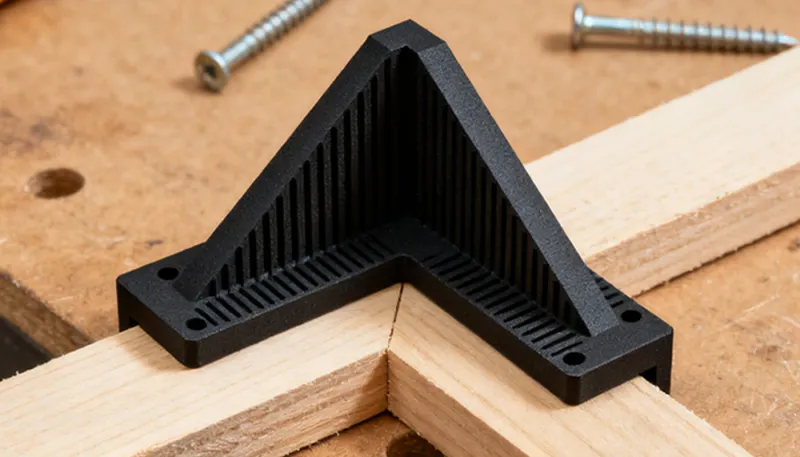
Choosing between ABS and Nylon for functional parts depends on the mechanical, thermal, and environmental requirements of the application. ABS is a practical engineering thermoplastic known for its good strength, rigidity, impact resistance, and relatively easy processing. Nylon, meanwhile, is valued for its toughness, wear resistance, flexibility, and ability to handle demanding mechanical conditions. For high-performance applications, SUNLU PA6-CF provides a carbon fiber-reinforced Nylon PA option with enhanced strength and rigidity.
ABS vs Nylon: Which Material Offers Better Functional Performance?
When comparing ABS and Nylon, strength should not be considered as a single property. Each material offers a different balance of performance characteristics, so the better choice depends on how the finished component will be used.
ABS is widely used for functional prototypes, housings, brackets, covers, and mechanical components that require a balance of strength, rigidity, and impact resistance. It is also relatively easy to machine, sand, and finish after printing, making it practical for businesses that need functional prototypes with additional post-processing.
Nylon offers a different performance profile. It is generally recognized for its toughness, flexibility, abrasion resistance, and ability to withstand repeated mechanical stress. SUNLU PA6-CF is a Nylon PA filament developed for high-strength engineering parts, adding high rigidity and strength to the typical performance advantages associated with Nylon.
What Makes ABS a Practical Choice for Functional Parts?
ABS remains a popular option for functional 3D printing because it provides a useful combination of strength, rigidity, and impact resistance. Compared with many general-purpose plastics, ABS is better suited to parts that need to withstand mechanical loads while maintaining a relatively rigid structure.
Another advantage of ABS is its established use in industrial and consumer applications. It can be suitable for protective housings, enclosures, brackets, fixtures, and prototypes where the part needs reasonable mechanical durability without requiring the specialized properties of reinforced engineering materials.
ABS can also be easier to process after printing. Parts can be sanded, drilled, or otherwise finished when required. For businesses producing prototypes or low-volume components, this can provide greater flexibility during product development.
However, ABS can be sensitive to printing conditions. Warping and layer adhesion can become concerns, particularly when printing larger parts. A controlled printing environment can therefore be important when dimensional accuracy and consistent production quality are required.
Why Consider Nylon for More Demanding Mechanical Parts?
Nylon is often selected when functional parts need greater toughness and resistance to repeated mechanical stress. Its combination of toughness, flexibility, and wear resistance makes Nylon particularly relevant for components that experience movement, friction, impacts, or repeated loading.
This creates an important distinction in an ABS vs Nylon comparison. ABS can provide useful rigidity and impact resistance, but Nylon can offer a more balanced combination of toughness and mechanical durability for certain demanding applications.
SUNLU PA6-CF takes this Nylon-based approach further by incorporating carbon fiber reinforcement. As a carbon fiber 3D printer filament it is positioned for high-strength engineering parts that require increased rigidity and strength compared with conventional Nylon.
For businesses producing functional components, this can make Nylon PA worth considering when standard ABS does not provide the desired combination of mechanical performance.
Impact Resistance and Toughness: ABS vs Nylon
Impact resistance is important when functional parts may be dropped, struck, compressed, or exposed to sudden mechanical loads.
ABS has good impact resistance and can perform well in housings, covers, brackets, and other components that need to tolerate occasional impacts. Its relatively rigid structure also makes it useful where the part needs to maintain its shape during normal use.
Nylon, however, is known for its toughness and ability to absorb mechanical stress. This can make it attractive for parts that experience repeated impacts or dynamic loading.
SUNLU PA6-CF combines the toughness associated with Nylon with carbon fiber reinforcement for greater rigidity. This provides businesses with another option when a functional component needs both toughness and structural strength.
Heat Resistance and Dimensional Requirements
Temperature is another important consideration when selecting a material for functional parts. ABS offers useful heat resistance compared with many common 3D printing plastics and can be appropriate for components exposed to moderately elevated temperatures.
However, applications involving more demanding thermal conditions may require a more specialized material. SUNLU PA6-CF has a heat deflection temperature of up to 209°C, providing a clear reference for businesses evaluating Nylon PA for high-temperature engineering applications.
Dimensional requirements should also be considered. ABS can provide good dimensional accuracy when printing conditions are properly controlled, but larger ABS parts may experience warping during cooling.
Nylon can also require careful moisture management before and during printing. For professional production environments, proper filament storage and drying can therefore be essential for maintaining consistent print quality.
When Should Businesses Choose ABS or Nylon?
The choice between ABS and Nylon should ultimately be based on the operating conditions of the finished part.
ABS can be a practical choice for functional prototypes, housings, fixtures, brackets, and general mechanical components where good rigidity, impact resistance, processability, and cost efficiency are priorities.
Nylon can become more attractive when the application involves repeated mechanical stress, friction, impacts, or greater requirements for toughness and durability. For even higher-strength applications, carbon fiber-reinforced Nylon such as SUNLU PA6-CF can provide additional rigidity and strength.
ABS vs Nylon: Selecting the Right Material
There is no universal winner in the ABS vs Nylon comparison. ABS offers a practical combination of rigidity, strength, impact resistance, and ease of post-processing, making it suitable for many functional applications. Nylon provides greater emphasis on toughness, flexibility, wear resistance, and resistance to repeated mechanical stress.
For businesses selecting materials for engineering parts, the right approach is to evaluate the actual demands of the application rather than choosing a filament based only on its general strength.
When a project requires the balance of performance offered by Nylon, SUNLU PA6-CF provides a high-strength Nylon PA filament with carbon fiber reinforcement. When the application prioritizes practical functionality, rigidity, impact resistance, and straightforward post-processing, ABS may remain a suitable option.