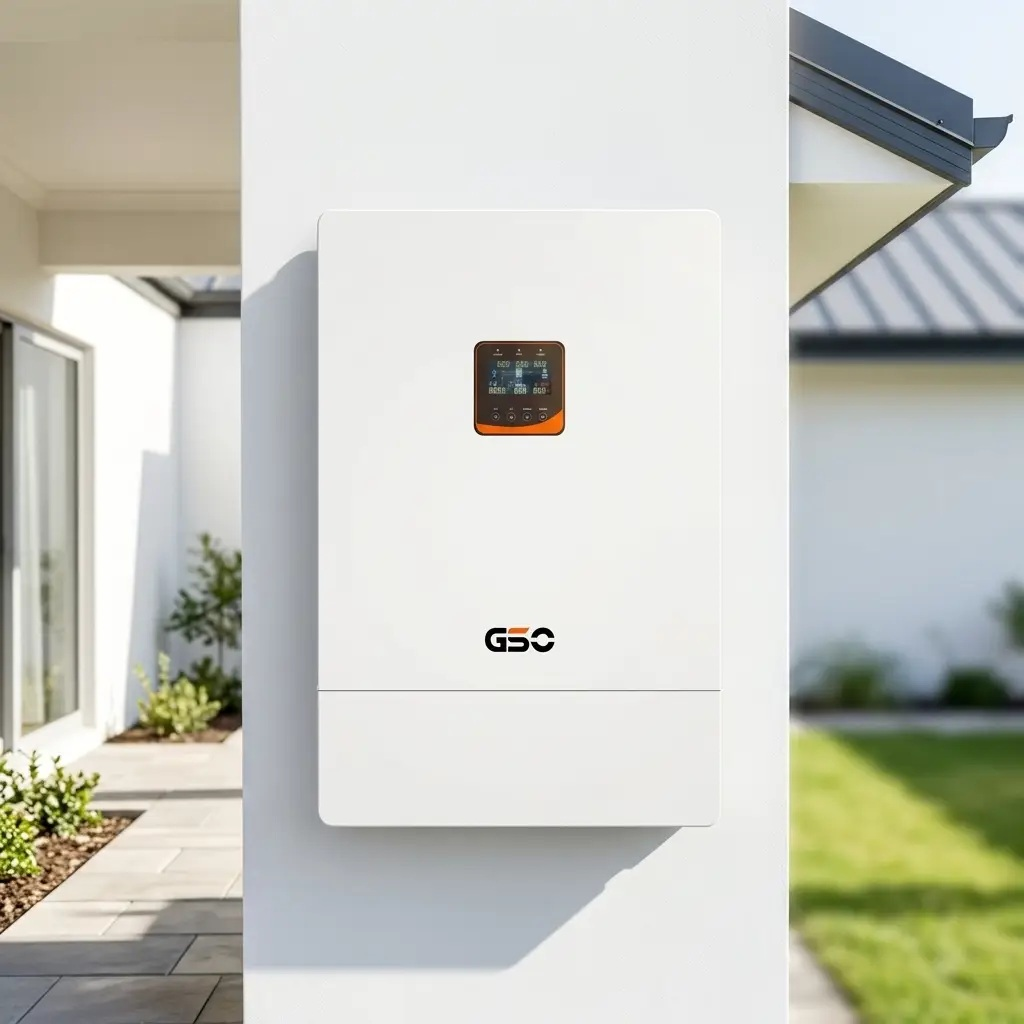
In a solar-plus-storage installation, the inverter sits at the junction between several electrical sources and loads. It may receive DC power from the PV array, manage battery charging, supply AC loads, interact with the grid and change operating mode during an outage.
A hybrid inverter for solar panels is built to coordinate those functions rather than handling PV conversion alone. The practical value of a solar hybrid inverter therefore depends on its power rating, PV input window, battery interface, transfer behavior, communication options and the type of installation it is expected to serve.
Rated Output and Peak Power Describe Different Limits
Continuous output is the first figure to read because it indicates the normal load level the inverter is designed to supply. GSOpower’s GST European-standard single-phase series offers 3.5 kW, 5.5 kW, 8 kW and 10 kW rated-output models. A hybrid inverter for solar panels should be matched to the sustained demand of the property rather than selected only from the highest short-duration figure.
Peak ratings on the same series are 6 kW, 10 kW, 12 kW and 15 kW, while the listed motor-load capacity ranges from 2 HP to 6 HP. The solar hybrid inverter provides 230 VAC rated output that can be configured for 200/208/220/240 VAC at 50 or 60 Hz, using a pure sine wave.
Those specifications matter where appliances or motors create brief starting loads above normal running power. Rated and peak output should therefore be read as separate limits: one describes sustained operation, while the other indicates short-duration capability under the conditions allowed by the equipment.
PV Input Windows Determine Array Compatibility
An inverter can only track and convert a solar array whose voltage and current remain inside its permitted PV range. Depending on the model, the GST series uses one or two MPPT channels and accepts maximum array power of 4 kW, 5.5 kW or 11 kW. For a hybrid inverter for solar panels, array sizing must therefore consider both total wattage and the electrical characteristics of each string.
PV input current is listed as 13 A, 22 A or 22 + 22 A, with open-circuit voltage reaching as high as 500 V per MPPT and an MPPT operating window of 120–450 V. The solar hybrid inverter has a stated MPPT tracking efficiency of 99.9%. These values establish the range in which the inverter can track the array effectively; they are not interchangeable with the AC output rating.
Battery Charging Adds a Second Energy Path
The battery interface turns the inverter into more than a PV-to-AC converter. Across the 40–60 V battery operating range, the 48 V GST platform accepts lithium, lead-acid and user defined battery settings. A hybrid inverter for solar panels can therefore coordinate energy from the array with stored energy, provided the selected battery remains within the required voltage and control conditions.
Charging limits vary by model. Charging-current limits depend on both the model and the source: maximum MPPT charging current is 60-200 A; mains charging current is 60-120 A; and hybrid charging current is 80-200 A. A solar hybrid inverter can use these paths to replenish storage from solar, the grid or a combined strategy, giving the installation flexibility to respond to generation levels and backup requirements.
Transfer, Parallel Operation and Communication
Backup performance depends partly on how quickly the inverter changes power paths. On the GST single-phase platform, the efficiency ceiling for battery-to-inverter conversion is 93%, and a typical inverter/bypass transition is specified at 10 ms. For a hybrid inverter for solar panels, those figures help describe behavior during a transition rather than the total amount of energy available from the battery.
Up to nine units can operate in parallel, expanding the role of the solar hybrid inverter beyond a single fixed output level where the installation design supports it. Communication interfaces include RS485, CAN, USB and dry contact, with optional external Wi-Fi or 4G modules.
These connections support battery communication, operating data and remote monitoring functions within a broader energy-management setup. Parallel operation also requires the overall installation to be designed for the combined power level, so the ability to connect multiple units should not be interpreted as permission to ignore cabling, protection or load distribution.
Use Cases Follow the Electrical Architecture
The GST series is built around European-standard single-phase solar-plus-storage applications. A hybrid inverter for solar panels in this category can combine PV conversion, battery charging, grid interaction and backup transfer for homes or other single-phase sites that need several power sources coordinated through one device.
Environmental and safety limits still shape the application. The solar hybrid inverter uses an IP20 enclosure, operates from -10 to 55°C, stores from -25 to 60°C, produces less than 60 dB of listed noise and uses a variable-speed forced-air fan. GSOpower lists CE certification to IEC 62109-1 and EMC compliance to EN 61000 for the platform.
Wattage is only one boundary in the inverter selection problem. PV string voltage, array power, battery type, charging current, load behavior, transfer requirements, communication and installation conditions all need to align. A hybrid design brings several energy paths into one device, so PV, battery and AC limits must remain compatible within the same operating configuration.