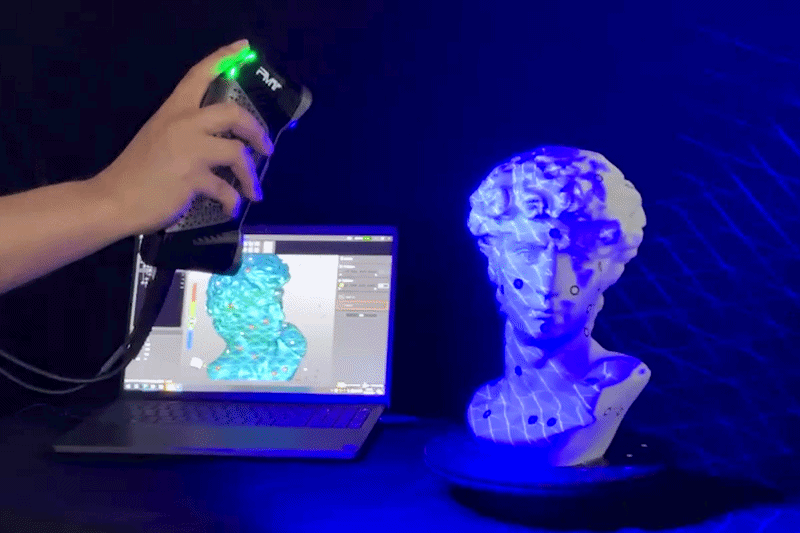
Portable 3D scanning gives manufacturers greater flexibility when inspecting components, reverse-engineering parts, or documenting complex surfaces away from a fixed metrology station. However, mobility raises a practical question for production engineers and quality managers: does the scanner run on an internal battery, an external power supply, or a connected computer? The answer depends on the model, its power consumption, and the supporting hardware required for data capture and processing.
Understanding these requirements helps manufacturers plan inspection workflows, estimate operating time, and avoid interruptions during on-site measurement. It also prevents purchasing teams from assuming that every portable device offers completely cordless operation.
Common Power Options for a Handheld 3D Scanner
A handheld 3D scanner generally uses one of three power arrangements: a rechargeable battery, an external AC power adapter, or power supplied through a connected computer or dedicated processing unit. Some systems combine these approaches, allowing operators to choose a configuration according to the inspection environment.
Rechargeable battery: Battery-powered models provide greater freedom of movement, particularly when inspecting large equipment, production lines, or components that cannot easily be transported to a laboratory. Runtime depends on battery capacity, scanner consumption, connected accessories, and workload.
External power adapter: A mains-powered configuration is useful for stationary inspection stations, extended measurement sessions, and applications where uninterrupted operation matters more than cable-free movement. Operators should confirm the adapter’s voltage, current rating, connector type, and regional compatibility.
Computer or processing-unit power: Certain scanners depend on a connected computer, controller, or dedicated processing unit. Even when the scanner itself consumes little energy, the complete system may require additional power for computing, illumination, data transfer, and display.
These arrangements are not interchangeable across all products. Technical documentation should establish which power sources a particular model supports before a manufacturer plans deployment.
Does a Portable Scanner Always Need a Battery?
The term portable describes ease of movement, not necessarily battery operation. A scanner can be portable because it is lightweight, easy to reposition, and suitable for measuring parts directly at their installation site, even if it needs an external power connection.
This distinction matters in industrial procurement. A quality team inspecting a large casting beside a machining cell may prioritize reach and measurement flexibility over cordless operation. An inspection team working across multiple facilities, meanwhile, may value battery-powered equipment because access to electrical outlets can be limited.
Before selecting a system, buyers should check whether the battery is integrated, removable, or optional. They should also establish whether the scanner can operate while charging, whether the computer requires separate power, and whether a battery pack is included in the quoted configuration.
How Power Consumption Affects Operating Costs
Power consumption influences energy use, heat generation, and the demands placed on a portable measurement setup. Lower consumption can be beneficial for mobile equipment, particularly when the system operates for long periods or draws power from a limited-capacity source.
PMT’s SMARTSCAN handheld 3D scanner is described as a low-power measurement solution with consumption as low as 4.8 W. This specification indicates the scanner’s stated power demand, but it should not automatically be interpreted as the consumption of the complete scanning workstation.
For battery planning, watt-hours provide a useful starting point. Theoretical operating time can be estimated by dividing usable battery energy in watt-hours by average power consumption in watts. For example, a 48 Wh battery supplying a device that continuously draws 4.8 W would provide approximately 10 hours under idealized conditions.
Actual runtime may be shorter because of conversion losses, battery aging, operating conditions, and the power requirements of connected equipment. Buyers should therefore request tested system-level runtime figures rather than relying solely on a portable handheld 3D scanner’s nominal consumption.
What to Check Before Buying a Battery-Powered Setup
For a portable handheld 3D scanner, procurement teams should confirm the complete power configuration rather than relying on the product name or portability claims. Important questions include whether batteries are supplied, what charger or power adapter is required, and whether the scanner needs a separately powered computer.
Other practical considerations include spare-battery availability, charging time, battery replacement costs, and the ability to maintain a stable power supply during long inspections. Facilities operating multiple shifts may benefit from spare batteries or a dedicated charging station if the selected model supports them.
PMT SMARTSCAN specifications list a 24 V/3 A input and USB 3.0 communication interface, alongside a stated power consumption of 4.8 W. Its listed weight of 530 g excludes the battery. These details make it important to confirm the supplied battery, adapter, and operating configuration directly with the manufacturer before estimating cordless runtime.
Match the Power Setup to the Inspection Workflow
The most suitable arrangement depends on where, how often, and for how long scanning takes place. A fixed inspection area with reliable electrical access may favor an external supply, while mobile teams may prioritize a verified battery-powered configuration. Manufacturers should also account for the computer and software used to process scan data.
PMT SMARTSCAN supports non-contact measurement of workpiece details and can be used for on-site industrial inspection. Its low power consumption and lightweight design may suit manufacturers seeking flexible measurement equipment, provided the complete system meets their operational requirements.
Make Power Planning Part of Equipment Selection
A portable handheld 3D scanner does not necessarily operate entirely on battery power. The correct setup depends on the portable handheld 3D scanner’s electrical specifications, included accessories, and computing requirements. Reviewing these factors before purchase helps manufacturers avoid unexpected downtime and accurately plan inspection operations.
For businesses evaluating PMT SMARTSCAN, the 4.8 W consumption figure is a useful starting point, but it is not a substitute for confirmed battery capacity or system-level runtime. Verifying those details with the supplier allows procurement teams to balance mobility, operating costs, and measurement continuity with greater confidence.