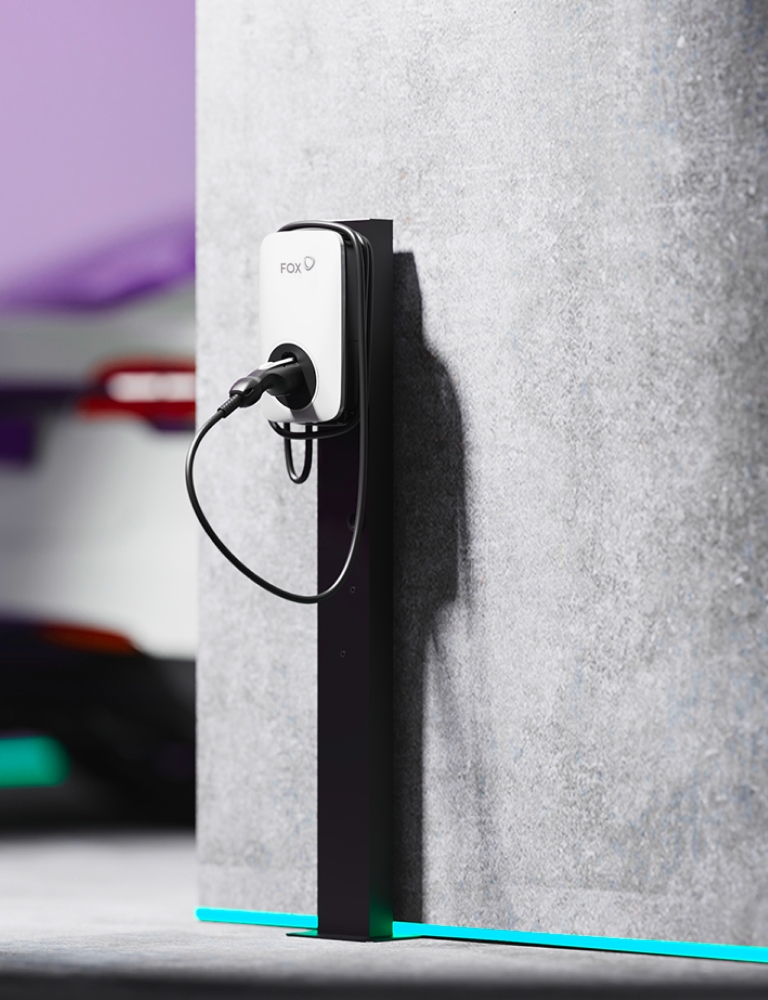
A solar-powered EV charger and a home battery are not inherently competing technologies. They can form part of the same residential energy system, provided the inverter, battery, charger, and control architecture are designed to communicate and manage power appropriately.
The important question is therefore not simply whether a charger can connect to a battery, but how electricity moves between solar generation, storage, household loads, and the vehicle.
Fox ESS positions its EV chargers alongside batteries and hybrid inverters as components of an integrated residential energy ecosystem. Its EV charging portfolio specifically includes solar linkage and dynamic load balancing, making the relationship between solar generation, storage, and vehicle charging central to the system design.
A Solar EV Charger Can Work With Battery Storage — But the Architecture Matters
A typical home energy system can contain four major electrical elements: PV generation, a battery, household loads, and an EV charger. The inverter provides the conversion and control functions that allow these components to operate as part of the same electrical system.
Compatibility therefore depends on the architecture rather than the presence of a battery alone. The charger needs to be capable of receiving power within the home’s electrical setup, while the wider system needs to manage available solar generation, battery operation, and household demand.
That distinction matters for homeowners considering a home EV charger. A charger described as “solar compatible” should not automatically be assumed to draw directly from the battery or prioritize solar in every operating condition. Those functions depend on the system’s configuration and control logic.
The Hybrid Inverter Creates the Electrical Connection
The hybrid inverter is particularly important in a solar-plus-storage installation because it connects solar generation and battery storage with the home’s electrical system. Fox ESS offers hybrid inverter products designed to work with its battery portfolio, creating an architecture in which generation and storage can be managed together.
This connection helps determine how EV charging fits into the home’s overall energy flow in a solar-powered EV charging system. Household loads, storage, or other linked purposes can get solar power, depending on system circumstances and management.
Fox ESS’s Smart Energy 2026 presentation describes its EV charging solutions as working across its inverter portfolio, reinforcing the role of the inverter as a bridge between charging and the wider energy system.
The result is different from installing an EV charger as a completely independent appliance. Charging becomes another managed electrical load within the home.
Battery Storage Changes How Solar Power Reaches the Car
Solar production and EV charging do not always happen at the same time. A vehicle may be parked at home during the day, but it may also need charging in the evening, overnight, or at another time when PV output is lower.
Battery storage introduces another pathway for managing that mismatch. Excess solar generation can be stored, while later household demand can draw on stored energy according to the configured energy strategy.
Fox ESS describes its residential batteries as part of its home energy storage portfolio, with systems designed around different storage requirements. The company’s Smart Energy 2026 materials also connect higher-capacity batteries with growing EV adoption, noting that additional vehicle charging demand can increase the value of available household storage.
Consequently, the battery does not need to be viewed as a dedicated “EV battery.” It remains part of the home’s overall energy system, while the charging load becomes one of the uses that the system can manage.
Solar Linkage Makes the Charger Part of the Energy System
Direct solar integration is one of the clearest indicators that an EV charger has been designed for a solar-powered home rather than simply added to one.
Fox ESS’s L Series EV Charger explicitly lists “Solar Linkage” as a feature and states that PV power can be used directly. The product range also includes dynamic adjustment of charging power, allowing charging power to respond to system conditions.
This gives installers a clearer path toward integrating EV charging into a PV-based home energy architecture. Instead of treating solar generation and vehicle charging as unrelated systems, the charger can participate in the home’s broader electricity management.
When choosing a solar powered EV charger, homeowners may find this distinction helpful. Maximum charging power is not the only important parameter. Solar input, battery storage, inverter management, and charging priority are all factors that the buyer should determine.
Dynamic Load Balancing Keeps Multiple Loads in Check
An EV charger can represent a substantial electrical load, particularly when other appliances, heating equipment, or battery-related activity is occurring simultaneously. Managing the charging load therefore becomes important for the overall electrical architecture.
Fox ESS lists dynamic load balancing on its EV charger products and describes it as a function that dynamically adjusts charging power. Its Smart Energy 2026 announcement similarly highlights dynamic load balancing as part of its integrated charging approach.
That capability changes the role of a home EV charger. Rather than operating at one fixed charging level regardless of what else is happening in the house, charging power can be adjusted according to available electrical capacity and system conditions.
This kind of coordination is more important for a house that uses PV, storage, and electric vehicle charging than just choosing a charger with a higher rated output.
What the Fox ESS Architecture Means for Homeowners
Yes, a solar EV charger can be compatible with home battery storage, but effective compatibility depends on the complete system architecture. The inverter, battery, charger, and control functions need to work together rather than being evaluated as unrelated products.
Fox ESS provides a concrete example through its combination of hybrid inverters, residential batteries, and EV chargers with solar linkage and dynamic load balancing.
The real-world lesson for homeowners is to look at the energy flow rather than the labels on individual products. Within a single electrical framework, a well-integrated system may manage solar generation, storage, domestic consumption, and electric vehicle charging.
That is what makes compatibility meaningful: the vehicle does not simply receive electricity from a charger; it becomes another controllable load within a connected home energy system.