Modern farm management increasingly depends on accurate information about where equipment is operating, how field tasks are being performed, and where automation can replace repetitive work. Precision agriculture companies address these needs by combining positioning, sensing, automation, and data technologies rather than providing only a single navigation product.
For farmers, agribusinesses, machinery manufacturers, and system integrators, the useful question is therefore what these services can actually contribute to daily operations. Archimedes Innovation describes its smart agriculture offering around GNSS technology, IoT sensing, intelligent data analytics, automated guidance, and data-driven field management.
Farm Management Starts With a Digital View of the Field
Effective management requires a dependable reference for machinery and field activity. Satellite-based positioning can establish where equipment is operating, while connected sensors can provide additional information about operating conditions.
This creates the foundation for precision agriculture solutions because field operations can be planned and executed against measurable spatial information rather than relying entirely on manual estimation. Archimedes Innovation’s smart agriculture platform specifically combines GNSS technology, IoT sensing, and intelligent data analytics across the agricultural lifecycle.
For B2B customers, this service layer can be particularly relevant when integrating agricultural machinery with digital farm-management workflows. Positioning becomes the common reference through which automated equipment and field information can be coordinated.
Precision Positioning and Automated Guidance
One of the most direct services offered is high-precision positioning for agricultural machinery. Conventional satellite positioning can establish a machine’s general location, while differential positioning technologies can provide the accuracy required for controlled field movement.
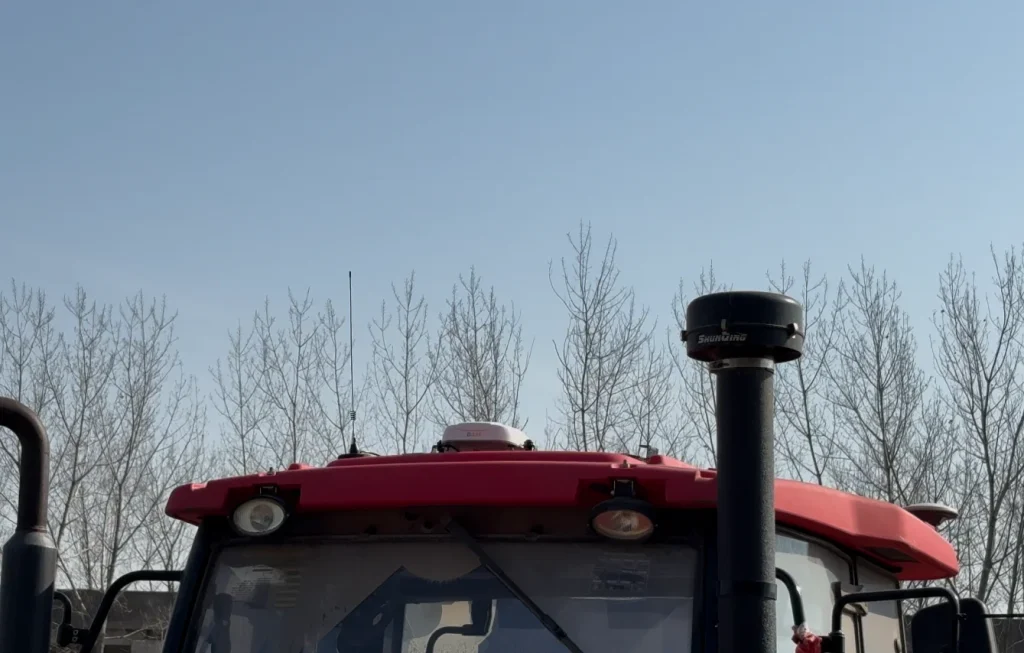
AS10, for example, uses navigation satellite differential technology to obtain centimeter-level positioning and controls the steering wheel through a torque motor so agricultural machinery can automatically follow a planned route.
That capability supports a practical farm-management function: keeping machinery on repeatable paths. Planting, cultivation, spraying, and harvesting can all involve repeated passes, making automated guidance relevant where operators need consistent route following.
The service is therefore more than location tracking. It connects positioning with machine control, turning field coordinates into physical steering behavior.
Robotic Support for Difficult Agricultural Tasks
Automation services can also extend beyond tractors. Agricultural robots can address tasks in locations where conventional machinery is difficult to operate efficiently.
The EVA1 spray robot listed by Archimedes Innovation uses a tracked chassis, remote control, and high-precision positioning. It is designed for spraying in remote-control or automatic modes, with particular suitability for mountain orchards and greenhouses.
For farm managers, this type of service addresses a different operational requirement from tractor guidance. Instead of optimizing repeated tractor passes, robotic equipment can provide a platform for targeted work in environments with challenging terrain, restricted access, or specialized crop layouts.
Such capabilities demonstrate that precision agriculture solutions can include both machine guidance and autonomous or remotely operated agricultural equipment.
Connected Sensing and Field Data
Position alone does not describe the condition of a farm. Sensing technologies can add another layer of information, helping systems observe physical conditions and operational activity.
Archimedes Innovation identifies IoT sensing as part of its smart agriculture approach. Combined with positioning, sensing can associate collected information with specific locations or operational contexts.
This relationship matters because farm management often involves decisions that vary spatially. A field is not necessarily uniform from one area to another, so geographically referenced information can support a more detailed understanding of where activities occur and where conditions differ.
For equipment developers, this also creates opportunities to connect sensors with positioning and automation hardware rather than treating each subsystem as an isolated component.
Turning Operational Data Into Better Decisions
Data analytics represents another service layer provided by technology-focused agricultural companies. Once positioning and sensing systems generate information, analytics can help transform raw observations into information that supports management decisions.
The objective is not simply to collect more data. Farm managers need information that can be interpreted within an operational context, such as where machinery has traveled, which areas have received a particular operation, or how field activities relate to planned routes.
Archimedes Innovation identifies intelligent data analytics and data-driven field management as components of its smart agriculture offering, alongside positioning and automated guidance.
For B2B customers, this creates a broader integration opportunity: navigation hardware, sensors, machine-control systems, and software can contribute to a connected agricultural workflow.
Choosing Services Around the Farm Workflow
The right service mix depends on the problem being managed. A farm seeking more consistent tractor movement may prioritize RTK-enabled positioning and automated guidance. Operations involving difficult terrain may have greater interest in robotic platforms. Larger digital agriculture projects may require positioning, sensing, and analytics to operate together.
Smart agriculture is not just one product category, but rather an integrated set of location, perception, and automation technologies, according to Archimedes Innovation. Its broader product line includes precision agricultural machinery, GNSS receivers, attitude sensors, and positioning sensors, all of which may be incorporated into larger systems.
Ultimately, the services provided by precision agriculture companies are most valuable when they correspond to a specific farm-management workflow. Accurate positioning establishes where work happens; automated guidance helps control how machinery moves; robotic systems extend automation into specialized environments; sensing adds field information; and analytics helps turn that information into actionable insight.
With its smart agricultural product, Archimedes Innovation follows this integrated strategy by integrating GNSS, sensing, automated guidance, robotics, and data-driven management.
There is more to finding the right technology partner than just looking at the supplier with the most products. This is especially true for agricultural enterprises. This is the business that can integrate the necessary tech with the farm’s real operational goals, developing an automated system that syncs up field data with machine movement.