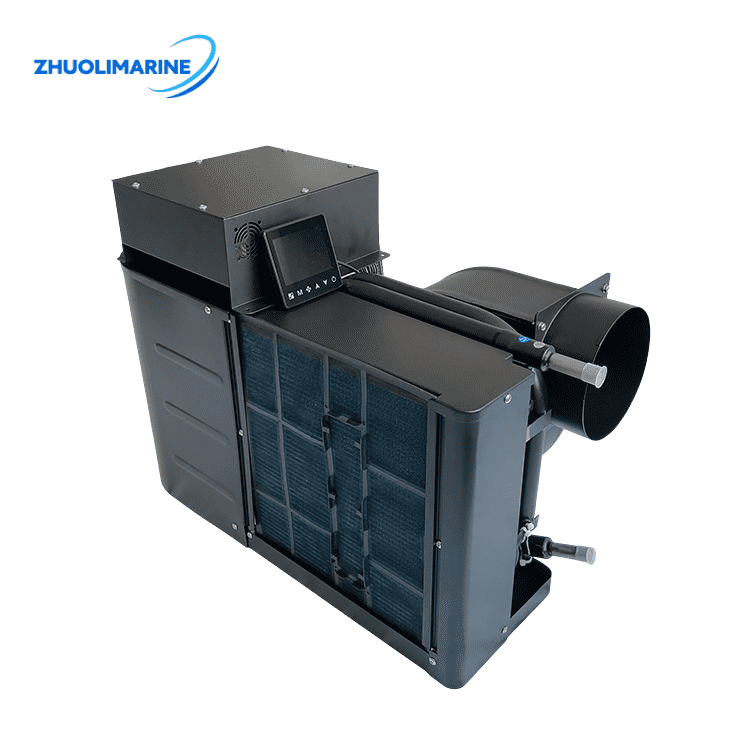
A compressor’s maximum input is not a prediction of how much electricity it will consume through an entire night. Cabin heat gain varies with sunlight, people, ventilation and outdoor conditions, so the work demanded of a cooling system changes over time.
A marine AC inverter arrangement adjusts compressor operation to changing conditions rather than relying solely on repeated full-speed starts and stops. The relevant outcome is energy accumulated over the actual cooling duty cycle, not a savings percentage inferred from the word ‘inverter’.
What Changes as the Cooling Load Falls
A conventional fixed-speed compressor typically runs at its designed operating speed when cooling is requested, then stops when the control reaches its set point. A variable-frequency drive can adjust compressor speed as the cooling demand decreases. The machine may consequently deliver less cooling while continuing to operate, instead of treating every small temperature correction as a fresh full-speed cycle.
That distinction is most relevant after the cabin has cooled down. Initial pull-down from a hot interior can still call for substantial output, while the steady conditions that follow may require less.
Fewer compressor restarts and smoother temperature control are possible advantages, but neither proves a particular reduction in daily electricity use. The duration of different operating states determines what the battery, generator or shore connection ultimately supplies.
Separate Compressor Control from Supply Voltage
Inverter regulation describes motor control; AC and DC labels describe how a unit receives electrical power. A battery-fed boat may use a DC marine unit without an intermediate household-style AC inverter stage. An AC system may instead suit a vessel already equipped with shore-power distribution or a generator. Conversion equipment, protection devices and auxiliary loads still affect the total electrical path.
Rated current varies with both supply voltage and model capacity. The 9,000 BTU MAR-12V/09BP is rated at 660 W and 55 A, while the 12,000 BTU MAR-24V/12BP specifies 1,020 W and 42.5 A. The 16,000 BTU MAR-48V/16BP lists 1,130 W and 23.5 A. These specifications should be compared according to the intended capacity and electrical configuration rather than treated as equivalent models.
These figures belong to ZhuoliMarine’s DC product range and describe feeder requirements, not how compressor power varies throughout a cooling cycle. A marine AC inverter assessment therefore separates voltage-specific nameplate ratings from the variable-speed duty cycle measured aboard.
Read Nameplate Power Without Inventing Savings
Published rated input provides a consistent starting figure, not a direct measurement of average power over a voyage. Maximum input describes a separate operating boundary.
Neither number says how long a compressor will run at any particular output when doors open frequently or sunlight strikes the cabin. Useful comparisons identify the exact model and distinguish those electrical figures from the cooling capacity stated in BTU per hour.
Two 16,000 BTU examples from ZhuoliMarine show how closely related cooling ratings can sit beside different electrical specifications. The AC MAR-220/16BP uses single-phase 220V at 60 Hz and lists 1,130 W rated input, 5.2 A and 1,280 W maximum input.
The DC 48V MAR-48V/16BP also lists 1,130 W rated input, but 23.5 A and 1,510 W maximum input. Both specify 650 m³/h airflow and 1,250 L/h seawater flow; equal rated watts do not establish equal real-world energy consumption.
Measure the Whole Cooling Duty Cycle
Energy is accumulated power over time. If a system averaged 600 W for six hours, the illustrative electrical use would be 3.6 kWh; a 1,000 W average over the same period would be 6 kWh.
These are calculation examples, not measured results for a particular marine unit. A meaningful onboard record needs power readings at suitable intervals and notes about cabin temperature, thermostat settings and outside conditions.
Testing a marine AC inverter installation also calls for consistency between comparisons. A cabin starting at 35°C and a cabin already near its set point impose different demands even if both have identical compressors.
Seawater-pump and blower consumption, electrical conversion losses and other equipment on the circuit can change the system-level result. A wattmeter capturing only the compressor will not necessarily describe what the vessel’s electrical supply experiences.
Include Controls and Installation in the Evaluation
Temperature settings influence how long the compressor works, while airflow restrictions can prevent nominal cooling capacity from reaching the occupied space. A water-cooled condenser likewise depends on adequate circulation.
The variable-speed feature does not overcome blocked grilles, a restricted seawater intake or unsuitable wiring. Correctly installed temperature control and the supporting air and water routes are essential conditions for any credible energy comparison.
These DC models include built-in Wi-Fi adjustment, and the MAR-220/16BP supports control of multiple units from one device. Such functions concern operating management rather than a guaranteed energy-saving percentage.
The appropriate test records actual conditions and complete electrical demand, then compares those observations with the published ratings without turning a single favorable operating point into an all-season promise.
An inverter label cannot substitute for a logged duty cycle, even for the AC and DC variable-frequency systems in ZhuoliMarine’s range with published electrical and flow specifications. An energy assessment should record total electrical use through a representative cooling period and evaluate it alongside the model’s voltage-specific ratings.