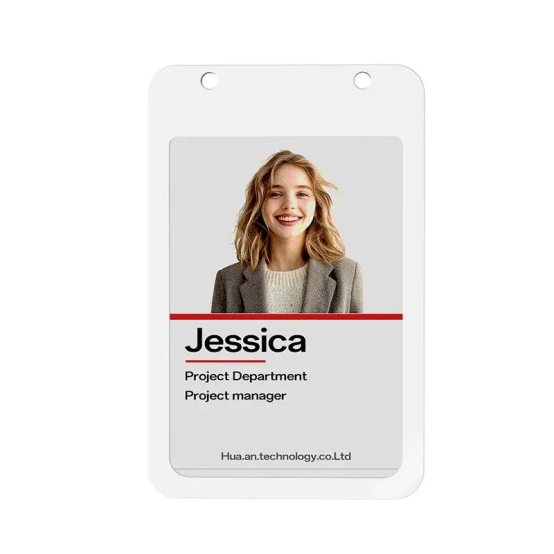
Electronic name badges are reusable identification displays that show names, roles, images, logos, or visitor details without printing a fresh card for every update. An e ink name badge works by keeping static information visible on an e-paper screen until new content is sent to the device.
A buyer considering an e ink name tag manufacturer should examine display clarity, color support, update method, protection level, wearing comfort, and the type of event or workplace where the badge will be used.
SEEKINK’s T040E5HC official product information gives a specific example: a 4-inch four-color EPD badge with 236 PPI clarity, IP67 waterproof protection, cold-pressed sealing technology, a thin and lightweight body, and updating through an app or a cloud platform.
These details explain how a digital badge can combine identity display with repeated use. The key point is that the badge should make identification easier for the wearer, the organizer, and the visitor without adding a complicated technical burden.
Readable Identity on a Reusable Screen
The basic function of an e ink name badge is to make personal information visible while avoiding disposable printed inserts.
SEEKINK’s 4-inch T040E5HC provides enough area for a name, title, logo, photograph, visitor status, or event graphic. Its four-color EPD design allows more visual separation than a plain monochrome label, and 236 PPI clarity supports clean text and image presentation.
A paper badge may be simple, but it becomes wasteful when names, departments, or event roles change often. A digital badge can be updated and worn again across different occasions. It is especially relevant for exhibitions, conferences, workplaces, training programs, reception teams, and temporary visitor management.
The badge should still remain easy to read at a normal viewing distance; decorative possibilities are secondary to clear identification. SEEKINK’s official specifications point to a product built for repeated name display rather than single-use labeling. Good badge content should be arranged with enough spacing, because a reusable digital display is only effective if the name and role can be recognized quickly.
Updating Methods and Content Management
A key difference between digital and printed identification is the way content is changed. An e ink name tag manufacturer should provide a practical method for updating badges without making staff repeat the old paper workflow in digital form. SEEKINK states that the T040E5HC can update images through an app or a cloud platform.
That allows badges to show different names, job titles, group labels, or visitor information as events and personnel needs change. The process can help organizers prepare badges before a session, correct information when a role changes, or reuse the same badge for a later event. Good content management remains important because an electronic screen does not fix inaccurate data by itself.
Names must still be entered carefully, display layouts should be tested for readability, and staff should know how to update the units. The value lies in reuse, faster revision, and cleaner presentation. For large events, this flexibility can be useful when speakers, staff, temporary guests, or contractors need different information during different parts of a program.
Protection, Wearing Comfort, and Use Conditions
A third factor is whether the badge can survive normal handling. An e ink name badge may be worn during long events, moved between departments, stored after use, or handled by many people. SEEKINK’s T040E5HC includes IP67 waterproof protection and cold-pressed sealing technology, which are relevant when badges are used repeatedly rather than discarded.
A thin and lightweight design also matters because an identification device must not feel awkward on clothing or lanyards.
The e-paper display is suited to static names and graphics, not motion-heavy content. That limitation is acceptable because a badge normally needs stable identity information. Buyers should consider the charging and updating routine, how many badges are needed, how they will be assigned, and whether they must match event branding.
The strongest use case is not novelty; it is consistent, reusable identification that can be changed when needed. Comfort also affects adoption; if the badge is too heavy or awkward, staff may avoid wearing it, which would weaken the value of the display system.
- paper name badges work by replacing fixed printed inserts with a reusable display that can be refreshed for different people or occasions.
SEEKINK’s T040E5HC shows how a compact badge can combine color EPD display, clear resolution, app or cloud updating, waterproof design, and repeated use. An e ink name tag manufacturer should be judged by whether those features support reliable identification in real environments.
When the goal is to manage names, roles, logos, and visitor information with less printing, an e ink name badge can provide a practical alternative to disposable badge materials. Organizations can also test several layouts before a large event, because name length, logo size, and color choices can affect readability more than the hardware specification alone.
A stable update process is especially important when badges are reused by different people, because the previous owner’s details must be fully replaced before the badge is issued again. Clear storage and check-in procedures can prevent confusion at registration desks. SEEKINK gives that final review a clearer product basis through its official badge details, update methods, and sealed construction.