Factory floors do not forgive hesitation. A robot that pauses to think, a gateway that lags behind a sensor feed, or an HMI that stutters under load all translate into lost throughput, and in industrial settings, lost throughput has a direct dollar figure attached to it. The processor sitting inside that equipment quietly determines whether it keeps pace.
Industrial IoT Runs on Split-Second Decisions
Modern factories, warehouses, and utility networks generate a constant stream of sensor data, and much of it loses its value if it is not acted on almost immediately. A vibration anomaly on a conveyor motor matters far more if it is caught before the bearing fails than if it is logged for a report reviewed the following week.
This is the operating reality behind industrial IoT deployments today. Devices are expected to sense, interpret, and respond locally, since round-tripping every reading to a distant server introduces delay that a fast-moving production line simply cannot absorb without cost.
Why Human-Machine Interfaces Need More Processing Headroom Than Ever
Industrial HMIs have quietly evolved from static status panels into interactive dashboards running live analytics, video feeds, and predictive maintenance alerts. Rendering this smoothly, alongside handling multiple sensor inputs, demands a processor built for sustained graphics and compute performance rather than a stripped-down embedded chip.
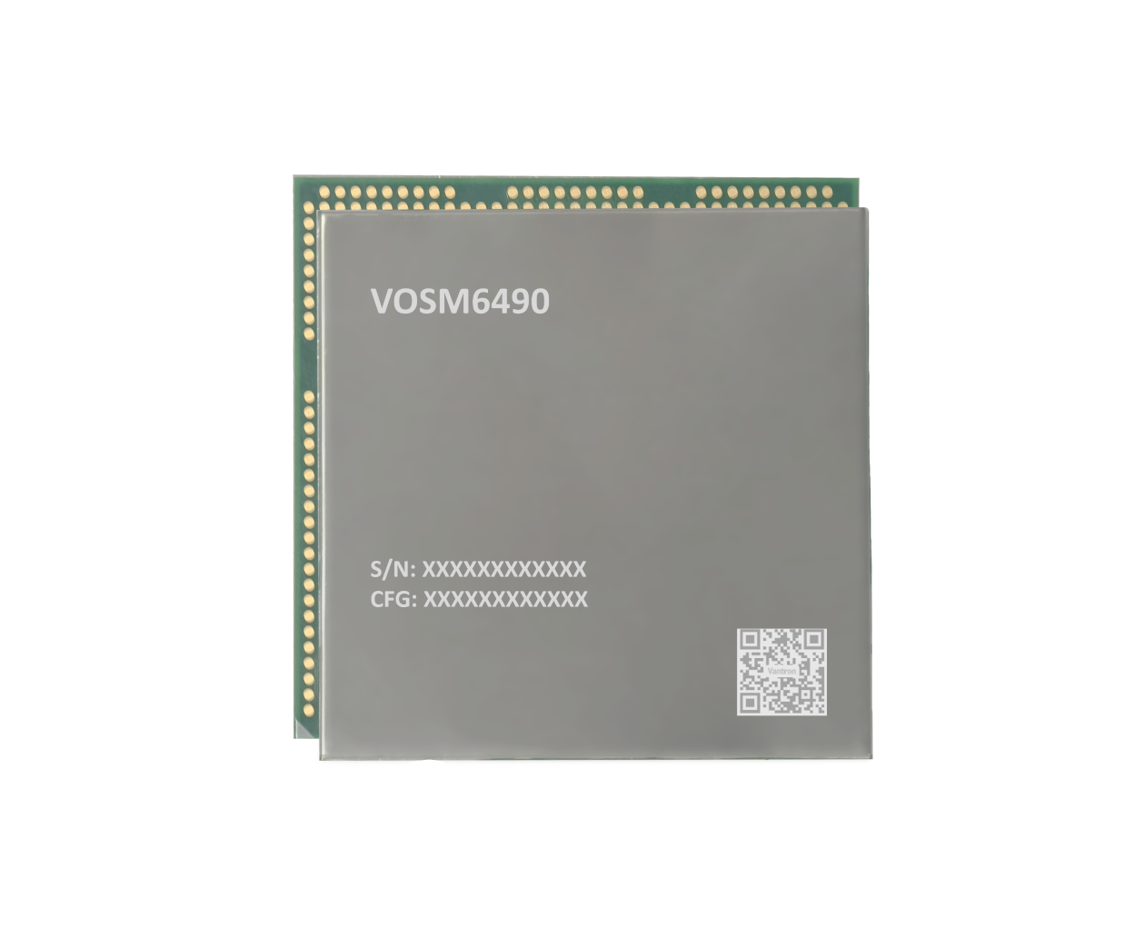
A capable Qualcomm SoM meets this demand directly. Vantron’s VOSM6490, built on the Qualcomm QCS6490 platform, pairs an octa-core Kryo 670 cluster with an Adreno 643 GPU, giving industrial HMIs enough graphics and processing capacity to display live data without the lag that frustrates operators relying on it every shift.
Autonomous Mobile Robots Depend on Local Inference
Autonomous mobile robots and AGVs cannot afford to wait for a cloud service to confirm a path is clear. Obstacle detection, navigation correction, and collision avoidance all need to happen in the milliseconds between sensing and acting, which places enormous pressure on the onboard compute platform to run vision models locally and reliably.
The VOSM6490’s Hexagon NPU, rated at up to 12 TOPS, is built precisely for this kind of workload. Combined with support for a 64MP camera ISP and 2160p video processing, it gives AMR platforms the ability to run object detection and path-planning inference on the device itself, rather than depending on a network connection the warehouse floor cannot guarantee.
Industrial Gateways Need Reliability as Much as Raw Speed
Not every industrial IoT device is judged primarily on processing power. Gateways sitting between field equipment and enterprise systems are judged on uptime, protocol compatibility, and the ability to run unattended for years in cabinets that see dust, vibration, and temperature swings far outside a typical office environment.
This is where module-level specifications matter as much as chip performance. The VOSM6490 is specified for operation from -20°C to +60°C; the completed gateway still requires enclosure, vibration, ingress-protection, and EMC validation for its deployment environment.
Matching Silicon to Workload Across a Device Portfolio
Manufacturers building a full industrial IoT product line rarely need identical processing power across every device. A simple sensor aggregator has very different requirements from a machine vision inspection station, and a module family offering multiple performance tiers avoids overspending on silicon that a lighter-duty device will never fully use.
Vantron’s Qualcomm-based lineup extends beyond the VOSM6490 to lower-tier options such as the VOSM2290, built on the QCS2290 platform, giving manufacturers a way to scale processing power across a product portfolio without switching software ecosystems or re-architecting firmware for each device tier.
Vantron’s Role in Scaling Qualcomm SoM Across Industrial Deployments
Vantron brings these module tiers together within its broader embedded solutions portfolio, pairing Qualcomm-based compute with the connectivity and device management tools industrial deployments depend on. Its BlueSphere platform, including Gateway Manager and Mobile Device Management, extends this further by supporting remote monitoring and firmware updates across fleets of deployed devices.
Software continuity plays an equally important role in Vantron’s approach. Both the VOSM6490 and VOSM2290 support Android and Linux, letting manufacturers reuse application code across HMIs, robots, and gateways built on different module tiers, which shortens development time for each additional product variant.
Long-term availability rounds out the value proposition for manufacturers planning multi-year deployments. With an extended service life of seven or more years, a Qualcomm SoM selected today remains sourceable well into a product’s mature production run, protecting industrial customers from the disruption of an unplanned redesign partway through a device’s operational life.
Industrial IoT hardware succeeds or fails on details that rarely appear in a sales pitch: how it behaves at negative twenty degrees, how quickly it reacts to a sensor spike, and whether it is still available to order five years after launch. For manufacturers building the next generation of intelligent factory and field equipment, those details, more than any single benchmark, determine which platform earns a place on the production line.