RFID systems can identify multiple tags within a short period, but the actual number depends on tag density, reader performance, antenna placement, radio interference, and item movement. Businesses planning warehouse automation or production tracking need to consider these factors before selecting equipment. A reader’s maximum reading distance does not indicate how many tags it can process efficiently. Understanding the difference between tag capacity, reading speed, and identification accuracy helps purchasing teams set practical targets for their projects.
What Determines the Number of Tags Read?
The number of tags inside a reading zone affects how the system performs. When a few tagged items pass an antenna, identification is relatively straightforward. Hundreds of tags packed closely together create a more demanding environment. Tag orientation, overlapping materials, and signal strength can affect the results. Businesses should test representative products instead of relying only on estimated tag quantities.
Passive UHF RFID systems use anti-collision protocols to identify multiple tags during a reading session. These protocols coordinate tag responses and reduce communication conflicts. However, multiple tags are not necessarily identified at precisely the same instant. The number successfully read depends on the reader, tag response, protocol settings, and surrounding conditions.
Reading speed also differs from total tag capacity. A system that identifies 100 tags in one second performs differently from one that needs ten seconds to identify the same quantity. Buyers should measure tags identified within a defined period, unique tags recorded, and missed reads. These figures provide a clearer view of system performance.
How Antenna Placement Changes Reading Performance
Antenna placement determines which tags enter the reading zone and how reliably their signals reach the reader. Multiple antennas can cover different sides of a loading bay, storage aisle, or conveyor. Their positions should reduce blind spots while limiting unnecessary overlap. A 4 port RFID reader allows several antennas to connect to one device, subject to its supported configuration.
Tag materials can also affect reading results. Metal surfaces may interfere with conventional tag antennas, while liquids can absorb radio-frequency energy. Specialized tags may be needed for metal equipment, liquid containers, or other challenging applications. Tag orientation matters as well. Testing tags in their actual positions helps businesses identify problems before installing a system across an entire facility.
The surrounding environment deserves attention during site planning. Metal shelving, nearby RFID systems, electrical equipment, and reflective surfaces may affect radio performance. Dense storage layouts can create uneven coverage even when the reader has sufficient output power. Integrators should test the system under normal working conditions and adjust antenna positions to suit the site.
How Reader Settings Affect Tag Throughput
Higher RF output may extend the reading zone, but it does not automatically increase the number of tags identified per second. Excessive coverage can also capture tags outside the intended area. Adjustable output helps technicians control the reading zone and reduce unwanted reads. When evaluating a long range RFID reader, buyers should consider both the required distance and the accuracy of identification within that area. For more guidance on comparing UHF readers by read range, antenna ports, interfaces, and operating conditions, see RSTC’s UHF RFID reader selection guide.
Reader processing capability, supported RFID protocols, and communication interfaces also influence performance. Software must receive tag data, manage repeated records where necessary, and transfer useful information to inventory or production applications. A fast reader cannot compensate for a network bottleneck or an application that processes incoming records too slowly. The entire data path should be evaluated during system testing.
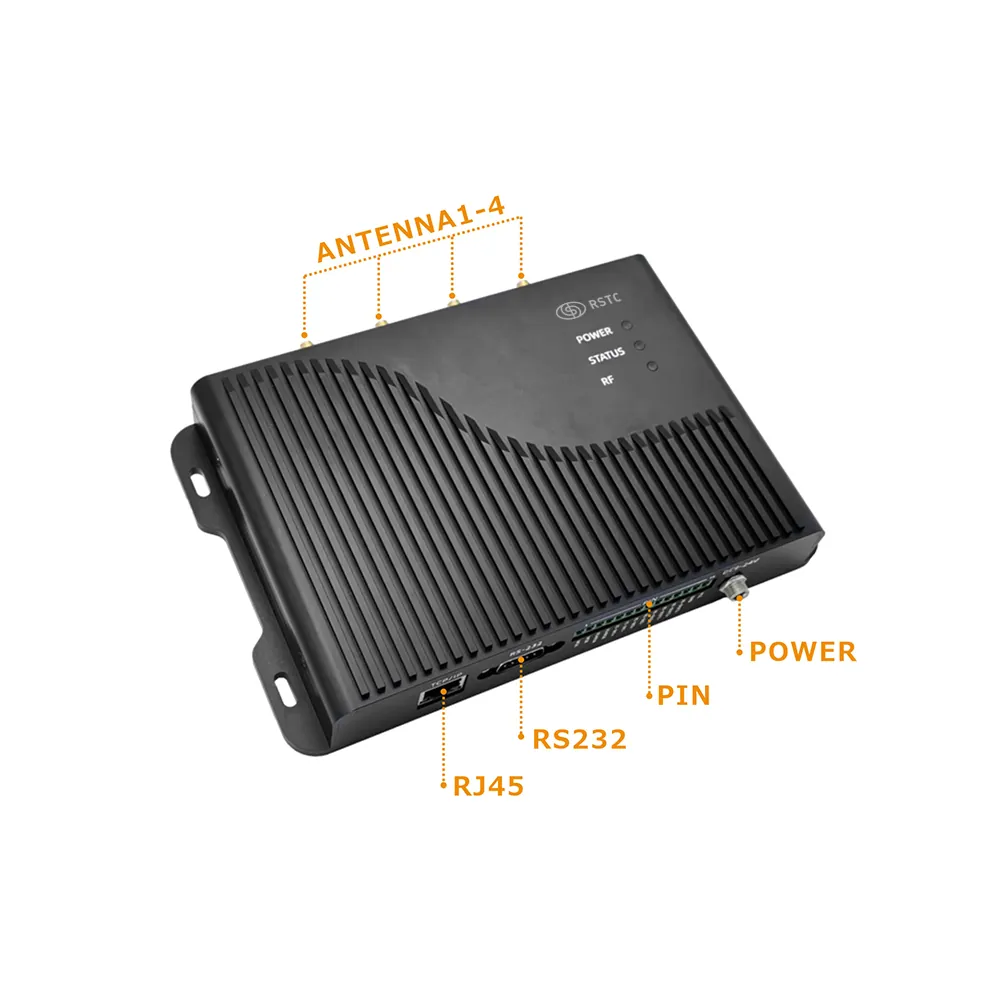
A four-port architecture can simplify antenna planning when several reading positions are required. For example, a warehouse entrance may need coverage across different sides of a pallet. A production line may require identification at separate process points. A 4 port RFID reader supports these layouts through multiple antenna connections, although the final arrangement depends on the required coverage and installation conditions.
What the RS-F905 Offers for Industrial Applications
For businesses comparing industrial RFID equipment, RSTC offers the RS-F905 Four-Port UHF RFID Reader. The device uses the Impinj E710 chipset and provides four external antenna ports with SMA interfaces. Its specified reading distance reaches up to 25 meters when paired with suitable UHF RFID antennas and tags. This figure describes the supported range, not a guaranteed distance in every environment.
The reader supports adjustable RF output from 5 dBm to 33 dBm in 1 dBm steps. Technicians can adjust this setting to suit different layouts and coverage requirements. A long range RFID reader with configurable output may help integrators manage reading zones across larger areas. Actual results still depend on antenna selection, tag characteristics, mounting positions, and local interference.
The RS-F905 is designed for applications such as warehouse operations, production lines, asset tracking, and parking management. Warehouse operators may need to identify pallets and update inventory records. Manufacturers may track tagged components at defined process points. Parking operators may use RFID identification within vehicle access systems. Each application requires its own reading range, response time, and data-handling plan.
How Businesses Should Test RFID Capacity
Before purchasing equipment, project teams should define measurable performance targets. These may include the expected number of tags per batch, identification time, acceptable missed-read rates, and the distance between tags and antennas. Testing should use the actual tags, materials, and movement speeds expected during daily operations. This process helps reveal practical limitations that laboratory figures may not show.
As an RFID equipment provider, RSTC supplies hardware options for projects requiring multiple antenna connections and extended reading coverage. Buyers should confirm compatibility with their software, network infrastructure, and intended tags before deployment. A pilot installation can help determine whether the equipment meets the project’s throughput and accuracy requirements.
The number of tags a reader can scan at the same time therefore has no universal answer. Capacity depends on the complete RFID setup rather than one specification alone. By testing tag density, antenna placement, RF output, and data processing together, businesses can make more informed equipment decisions and build systems suited to their operational needs.