A seamless visual display is essential for corporate conference rooms, broadcast studios, retail environments, and control rooms. Viewers expect images to appear continuous, with consistent colors, sharp details, and no distracting gaps between panels. Achieving this result requires more than high-resolution LED modules. It depends on pixel pitch, cabinet precision, color calibration, signal processing, and installation quality.
A professional indoor LED display combines these elements to create a unified viewing surface. For businesses investing in a large-format display, understanding these technologies helps them evaluate performance and choose equipment suited to their installation environment. Coblinks, a professional LED display manufacturer based in Shenzhen, China, offers indoor display solutions for commercial and professional applications.
- Fine Pixel Pitch Creates Detailed Images
Pixel pitch refers to the distance between the centers of adjacent pixels, measured in millimeters. A smaller pixel pitch generally provides higher pixel density, allowing an indoor LED display screen to reproduce text, graphics, and detailed images more clearly at close viewing distances.
For example, Coblinks’ MC Series offers pixel pitches ranging from 1.25 mm to 3.91 mm. Its finer-pitch configurations are suitable for applications such as meeting rooms, control rooms, and commercial displays where viewers may sit relatively close to the screen.
However, smaller pixel pitch is not automatically the best choice for every project. Buyers should consider the distance between the screen and the nearest viewer, the content being displayed, and the project budget. Selecting the appropriate pixel pitch helps achieve a clear image without unnecessary expenditure.
- How Precise Cabinet Alignment Reduces Visible Seams
Even high-resolution LED modules can produce a distracting image if their edges are not aligned accurately. Uneven cabinet positioning may create visible gaps, inconsistent surface levels, or lines that interrupt images across the display.
Manufacturers address this issue through precision-engineered cabinets, accurate mounting points, and alignment mechanisms. A stable support structure is equally important because uneven walls or frames can affect the final screen surface.
The Coblinks MC Series uses die-cast aluminum cabinets and incorporates magnetic module positioning and alignment features designed to support flatness. Its cabinet options include dimensions of 500 × 1000 mm, 500 × 500 mm, 500 × 250 mm, and 250 × 500 mm, with a listed depth of 45 mm.
These modular configurations allow installers to assemble displays suited to different screen dimensions. For an indoor LED display, accurate cabinet alignment helps maintain a consistent surface and reduces visual interruptions across adjoining panels.
- Color Calibration Maintains Uniformity Across the Screen
A seamless image must also look consistent from one section to another. Differences in LED brightness or color output can create visible patches, even when the cabinets fit together correctly.
Calibration helps address these variations by adjusting the output of individual modules or pixels. Brightness correction supports more uniform illumination, while color calibration helps maintain consistent tones across the entire screen.
The quality of the LEDs, manufacturing consistency, and display control system all influence the final result. Coblinks integrates components from established suppliers, including Novastar, Meanwell, and Epistar, into its display solutions. The specific components and calibration capabilities should be confirmed for the selected model and configuration.
For applications involving corporate presentations, branded content, and broadcast graphics, a properly calibrated indoor LED display screen can produce a more cohesive image. Calibration should also be checked during commissioning and after relevant module replacements or maintenance.
- Refresh Rate and Grayscale Improve Visual Performance
Seamless display quality involves motion and tonal transitions as well as physical alignment. Refresh rate describes how frequently the display updates its image, while grayscale determines how finely it can represent different brightness levels.
Coblinks’ MC Series specifies a refresh rate of at least 3840 Hz and 16-bit grayscale. These characteristics support smooth visual presentation and detailed tonal gradation when the complete display system is configured appropriately.
For broadcast studios and environments where cameras capture the screen, buyers should also assess camera shutter settings, frame rates, and processor compatibility. A high refresh rate alone does not guarantee flicker-free camera footage under every recording condition.
Signal processing is another important consideration. The sending controller, receiving cards, and display configuration must work together to maintain stable image output across the full screen.
- Installation and Maintenance Preserve Display Quality
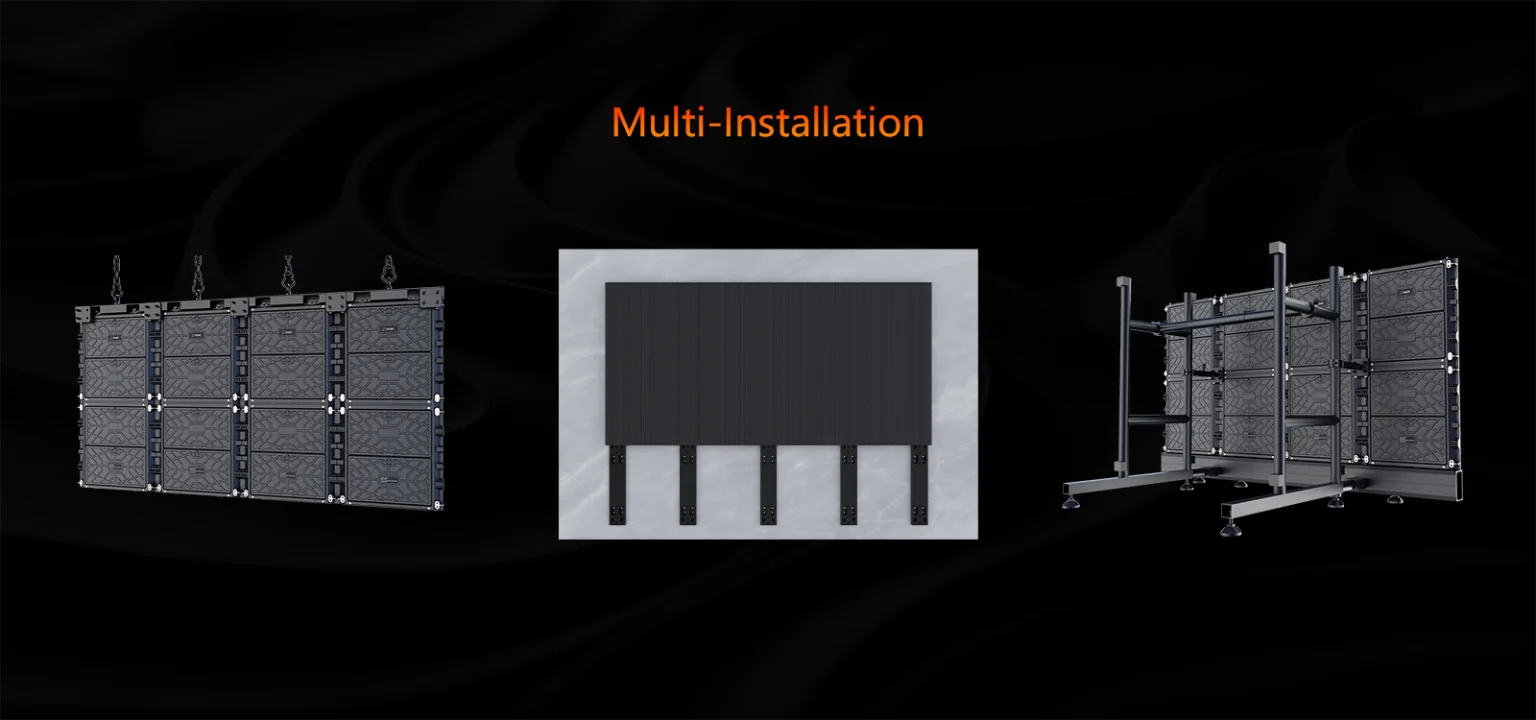
Even a well-designed indoor LED display requires correct installation to achieve its intended performance. Installers should verify the supporting structure, cabinet alignment, power distribution, signal connections, and ventilation requirements before commissioning.
Coblinks states that its MC Series supports front-access maintenance, allowing technicians to service selected components without requiring access behind the screen. This feature can be particularly useful in meeting rooms, retail environments, and control rooms where rear clearance is limited.
After installation, technicians should inspect cabinet joints, test image uniformity, check signal stability, and review brightness and color settings. Regular maintenance helps identify problems before they become noticeable to viewers.
When choosing an indoor LED display screen, buyers should therefore assess maintenance access alongside pixel pitch, cabinet construction, refresh rate, and the availability of technical support.
Conclusion
A seamless LED video wall depends on several technologies working together. Fine pixel pitch improves detail, precise cabinet alignment reduces visible seams, calibration supports consistent color, and appropriate processing maintains stable image output.
With its MC Series and other indoor display solutions, Coblinks serves businesses seeking modular LED technology for commercial and professional environments. By matching product specifications to viewing distance, installation conditions, and content requirements, buyers can select an indoor LED display that delivers a consistent and professional visual experience.