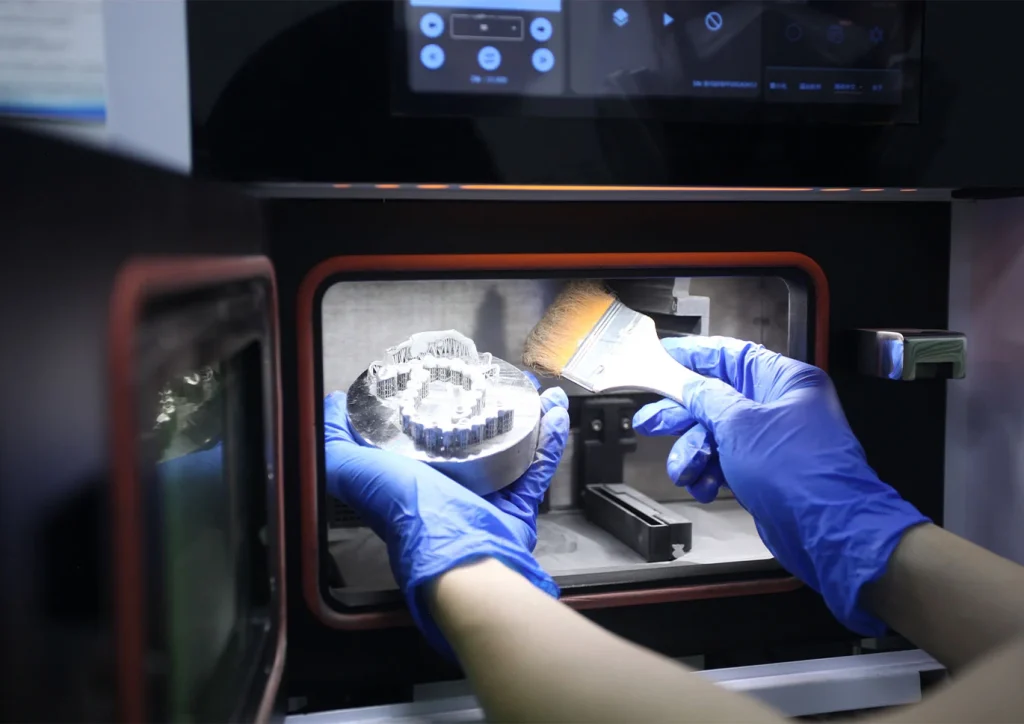
Buying an SLM printer becomes difficult when every supplier emphasizes different specifications. Laser power, build volume, scanning speed, and productivity figures can all look impressive, yet none answers the buyer’s central question: will the machine fit the intended production model?
Dental laboratories face an especially specific decision. Their workloads often involve relatively small but highly customized metal components. Consequently, the right machine is not necessarily the largest or most powerful option. It is the one whose configuration matches the parts, materials, workspace, and workflow that the laboratory actually operates.
What Must the Printer Actually Produce?
Part requirements should determine the initial shortlist. A laboratory producing crowns does not necessarily need the same build capacity as a manufacturer producing larger industrial components.
The geometry and quantity of parts also matter. Small dental components may allow multiple units to be arranged within a compact build area. Frameworks can create different spatial requirements. Understanding the normal production mix therefore gives buyers a realistic starting point.
Material selection creates another boundary. The printer must support the alloys required for the intended applications. MLAB, for example, lists CoCr alloy and titanium alloy among its supported melting materials. The product page also identifies dental crowns, frameworks, and lingual brackets as production examples.
That makes the first purchasing question straightforward: does the machine’s intended application match the parts the laboratory expects to manufacture?
Which Specifications Can Eliminate a Printer Immediately?
Once the application is clear, technical specifications become useful screening tools. Build area is one of the quickest filters. A machine cannot be considered suitable if its available volume cannot accommodate the required production arrangement.
MLAB provides a Φ100 × 90 mm melting area, including the build plate, with a stated layer thickness of 20–60 μm. Buyers can compare those figures directly against their normal part layouts and required production parameters.
Laser configuration deserves a similar examination, but laser power should not be viewed in isolation. MLAB uses a single 250 W fiber laser and lists a maximum scanning speed of 11,200 mm/s. The system also uses nitrogen or argon protective gas.
A best SLM 3d printer therefore emerges from specification matching rather than from one headline number. Buyers should identify which parameters are essential for their parts before comparing competing systems.
Can the Machine Fit the Laboratory Before Production Even Starts?
Physical compatibility can eliminate an otherwise suitable printer. Floor space, machine weight, temperature, humidity, power supply, and vibration conditions all affect installation planning.
MLAB has listed dimensions of 610 × 615 × 890 mm and a printer weight of 150 kg. Its stated footprint is approximately 0.36 m². For a dental laboratory operating in a constrained production area, those figures can be evaluated against the available installation space.
Environmental requirements also need verification before an order is placed. The product information specifies an operating temperature of 15–35°C, humidity of no more than 95%, and an environment without vibration. The listed input voltage is 220V.
Riton presents MLAB as a compact SLM system for dental laboratory use. For buyers, the practical lesson is simple: installation requirements should be checked during equipment selection, not after delivery.
Does the Stated Output Match the Buyer’s Real Batch?
Productivity figures become meaningful only after they are compared with actual batch patterns. A laboratory should ask how many units it normally wants to manufacture per cycle, rather than selecting equipment because its maximum output sounds attractive.
MLAB’s published information states that the system can print up to 100 crowns or seven frameworks in 2.5 hours under the fastest conditions. The same information notes that actual printing time varies.
That distinction matters during procurement. Real production involves different geometries, layouts, parameters, and operating conditions. Published maximums are useful reference data, but they should not automatically be treated as a laboratory’s expected daily throughput.
Powder management also belongs in this assessment. MLAB lists an upward powder-feeding structure, powder-quantity monitoring, and an optimized powder-spreading distance. Such details can be considered alongside production speed when assessing routine operation.
What Should Buyers Evaluate Beyond the Printer’s Hardware?
A machine purchase is also a workflow decision. The equipment must work with how operators prepare jobs, transfer data, monitor builds, and manage production.
MLAB supports wireless printing-data transmission and uses Riton Controller software. According to the product information, the software provides real-time printing status and progress feedback.
The comparison between 3d metal printer manufacturers should therefore extend beyond laser specifications. Buyers should examine whether the supplier’s system supports the operational practices required by the laboratory.
Powder-handling design and operational safety features also deserve attention. MLAB uses a pre-soaked circulation design that the manufacturer describes as preventing explosions during filter cleaning. Such equipment features should be assessed alongside the laboratory’s own safety procedures and applicable requirements.
When Does a Compact SLM System Make the Better Choice?
A compact system becomes attractive when its production envelope closely matches the buyer’s workload. There is little value in paying for unused capacity if most production consists of relatively small dental components.
The final evaluation can be reduced to a practical fit test: required alloys, part dimensions, build arrangement, expected batch volume, available floor space, environmental conditions, and operator workflow. Any major mismatch should carry more weight than an impressive isolated specification.
Riton’s MLAB configuration is particularly relevant to this type of evaluation because its published specifications combine a compact physical format with a 250 W fiber laser, Φ100 × 90 mm melting area, and support for CoCr and titanium alloys. Its listed dental production examples further clarify the intended use.
For purchasers comparing SLM 3D printer options, the strongest decision is therefore not a universal ranking. It is a documented match between production requirements and machine capabilities.
The same principle applies when comparing 3D metal printer manufacturers. A supplier should be judged by relevant technical evidence, application suitability, workflow functions, and the practical fit of its equipment. Riton’s MLAB demonstrates how a dental-focused SLM system can therefore be evaluated against build area, materials, production capacity, installation conditions, and workflow requirements.