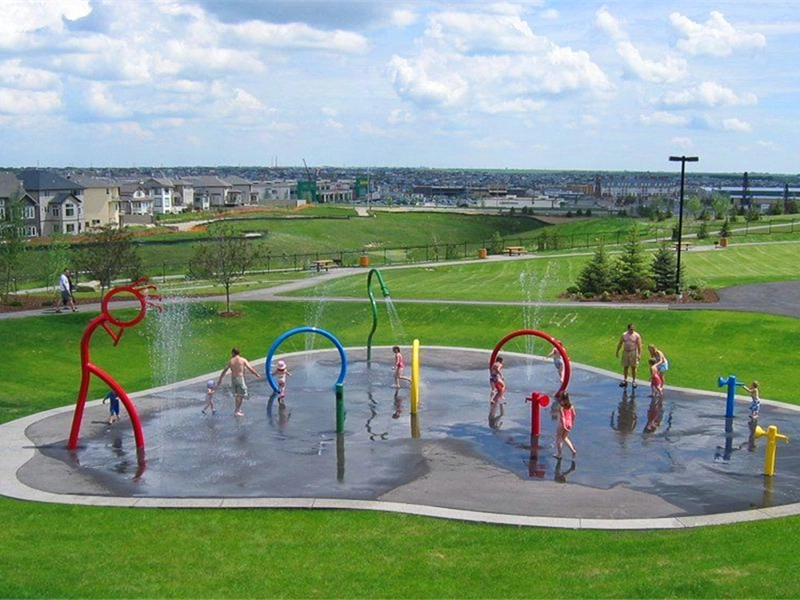
Resorts and parks that add a children’s water area often ask the same question: which features suit which ages? A toddler needs something very different from a ten-year-old, and equipment chosen for only one group leaves the rest bored or at risk.
The benefits of water play extend beyond entertainment, creating opportunities for children to explore coordination, communication, problem-solving, and sensory awareness. Jinchao recognizes the developmental value that well-planned aquatic play environments can add to family-oriented recreational spaces.
Choose Features by Age Group
For toddlers, low spray points, shallow zones, and gentle interactive features work best. Water should be soft and predictable, surfaces should be forgiving, and caregivers need to stay within reach, so seating and sightlines matter as much as the equipment.
School-age children look for challenge and movement. Taller structures, rotating features, dump buckets, and stronger sprays hold their interest, and paths that loop around the area let them choose their own pace.
Teenagers and families need a place too. A few larger features, shaded seating, and open space let older children and adults share the area without taking over the toddler zone. Dividing the area clearly lets each group enjoy it at its own intensity.
Encourage Movement and Problem-Solving
Water play naturally involves physical movement. Reaching toward a spray, walking between features, carrying water, pushing an object through a stream, or changing body position can involve balance and coordination. Water play child development is therefore connected not only with sensory exploration but also with opportunities for children to practice controlled movement.
Problem-solving emerges through experimentation. Children may adjust the position of an object to redirect water or repeat an action after observing an unexpected result. Unlike activities with a single predetermined outcome, water allows repeated trial and adjustment, giving children space to discover simple cause-and-effect relationships.
Interactive equipment can add another layer of physical exploration. Jinchao’s Kids Aqua Play facilities are available in stainless steel and fiberglass, with designs intended to create playful visual features and interactive water experiences. The equipment can provide different forms of water movement while becoming part of the wider landscape rather than functioning as a purely decorative installation.
Support Social and Cognitive Growth
Shared water environments naturally encourage communication. Children may imitate another child’s actions, exchange ideas about how a feature works, or cooperate while exploring the same activity. Such moments can support turn-taking and basic social negotiation without requiring the play experience to become structured instruction.
Language development can also emerge from observation. Children describe what they see, ask questions, name objects, or explain what they think will happen next. Early childhood sensory play can provide a rich context for these conversations because the experience is immediate and easy to demonstrate through physical action.
Cognitive development benefits from repetition as well. A child who repeatedly tests the same water feature may gradually recognize patterns and modify behavior based on previous results. These small experiments encourage attention, memory, prediction, and flexible thinking, all within an environment that remains playful rather than academic.
Design Play Environments Around Development
The surrounding environment influences how effectively children can explore. Open circulation, visible activity zones, suitable resting areas, and age-appropriate water features can give children enough freedom to experiment while allowing caregivers to remain nearby. Water play child development works best when the physical environment supports independent discovery without creating unnecessary barriers.
Design variety is equally valuable. Not every feature needs to produce the same type of response; different heights, directions, spray patterns, and interaction points can create distinct experiences. Such variety gives children opportunities to choose activities according to their interests, confidence, and current developmental stage.
Operators should also consider how the environment changes throughout the day. Noise levels, crowd density, weather, cleaning schedules, and supervision patterns can influence children’s behavior. A thoughtful water park manufacturer can contribute practical knowledge during planning, while developmental objectives should remain connected to the actual needs of the children and families using the venue.
Conclusion
Well-designed children’s water areas do not feel like a lesson, but they work because the equipment suits the age of the child using it. The right mix of low spray points, active features, and shared spaces gives resorts a facility that stays busy through the day and the season.
For operators developing family-oriented aquatic spaces, developmental considerations can sit alongside safety, maintenance, accessibility, and operational planning. A knowledgeable water park manufacturer can help translate these requirements into practical aquatic environments, while Jinchao’s children’s play solutions provide adaptable options for creating visually engaging water areas. Thoughtful design gives children room to explore, repeat, question, and discover—turning ordinary water interaction into a richer part of early development.