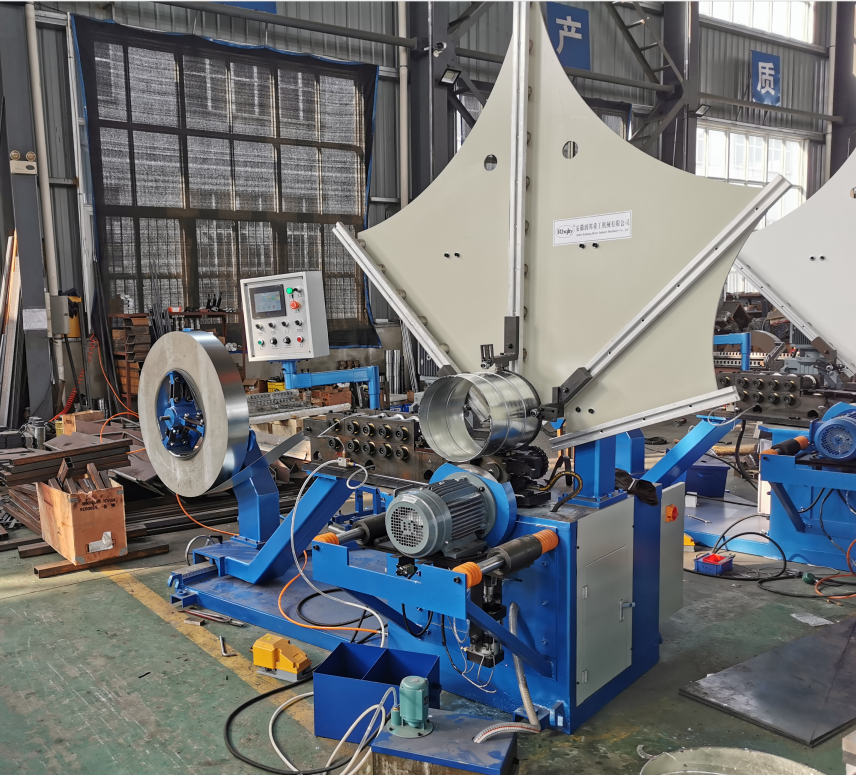
An order for identical round ducts repeats two requirements: maintaining tube form and separating the required number of lengths. A spiral duct machine can automate parts of that repetition without changing how a helical seam creates the tube. The distinction lies in the sequence performed by the equipment and the decisions still supplied by its operator.
Less automated arrangements leave actions to manual initiation, but traditional equipment does not represent one universal operating method. Forming, triggering a cut, counting finished lengths and ending a batch can each have different control arrangements. Separating those functions explains what an automatic mode actually changes, alongside the stock preparation and handling that remain necessary.
The Strip Still Has to Become a Seamed Tube
Metal strip develops the tube through forming and a helical joint between successive turns. The edges are brought together into the intended seam as the material advances around the forming arrangement.
A spiral duct machine therefore has to coordinate strip movement, curvature and seam formation before cutting length becomes relevant. Automatic counting cannot substitute for the physical relationships that produce the tube.
In a mold-type arrangement, the forming mold establishes a particular diameter. Changing the desired diameter requires a suitable mold and the associated setup, rather than only a new length entry on a screen. Diameter and length belong to different parts of the process: one concerns cross-sectional geometry, while the other determines where the formed tube is separated into a finished section.
The strip has a defined width and thickness. These affect the material presented to the forming and seaming elements, so a duct making machine needs stock compatible with its intended specification.
The seam consumes part of the strip’s edge geometry, and the resulting helical arrangement connects adjacent turns. Stock selection and seam preparation remain physical conditions even when subsequent cuts are controlled automatically.
Coil delivery is another part of that forming condition. The strip has to unwind at the rate required by the downstream mechanism, while a reel brake can restrain unwanted run-on when feeding changes.
Clearance for removing completed lengths matters alongside support for the tube. These functions surround the automatic cutting sequence; their presence and configuration determine how the material reaches and leaves the working station.
Who Triggers the Cut and Ends the Batch
Each length is cut from the tube before it is added to the batch. On a duct making machine, the cutting trigger and forming operation can have different levels of automation. An arrangement may form the tube while leaving the operator to initiate a cut. The operator’s role can extend to counting completed lengths and deciding when production ends.
Length and quantity are separate control requirements. The length setting concerns the intended size of each section, while the quantity setting concerns the number of sections in the run. Repeating a cut at the desired length and ending production after the required count are consequently different actions. Automatic operation connects those actions into a repeating sequence with a defined endpoint.
The SBJX-1600 mold-type system offered by Colgar provides both semi-automatic and fully automatic modes. In semi-automatic operation, the operator triggers cutting manually.
In automatic mode, a set quantity permits continuing production with automatic cutting and stopping when that quantity is reached. The difference concerns the repeated cut request and batch endpoint, without implying a different physical method of making the helical tube.
Other work needs separate provision. Coil replacement, installation of the required tooling and collection of completed sections do not follow automatically from a programmed cutting quantity.
Each automatic cut adds another section to the completed batch, so collection capacity has to accommodate the accumulating lengths of tube. The remaining tasks determine how personnel and handling equipment support that sequence in practice.
Why the Order Mix Changes the Value of Automation
A run of matching sections repeats the same cutting operation for every finished length. An automatic spiral duct machine can perform those cuts in sequence without a separate manual trigger for each section in the batch.
Frequent changes in required diameter create a different workload because tooling and forming setup become more prominent. Batch size alone consequently does not describe the complete operating task.
A mixed schedule at a duct making machine can include a length change, a diameter change or a different material requirement. Those changes have different consequences: a new length may alter the cut setting, whereas a different diameter in a mold-type system requires appropriate forming tooling. Grouping compatible orders can limit repeated setup, but the actual work still depends on the machine and stock involved.
The RBST-1500D from Colgar lists a 137mm strip width and a 100–1500mm duct-diameter range in its table. Those dimensions describe different things: the stock entering the helical process and the tube produced by it.
Changing diameter alters the curvature developed by the forming arrangement. Its stated synchronized cutting likewise identifies coordination of separation with tube production, rather than eliminating specification changes.
Automation changes which repeated actions depend on a fresh operator command. In Colgar‘s described automatic mode, length and batch completion govern the repeating cut sequence, while material and tooling preparation remain separate tasks. Buyers should prioritize automatic cutting and counting for long repeat runs and ask for a mold change demonstration if diameter changes dominate the schedule.