Industrial buyers evaluating gas detection in 2026 should compare sensor coverage, sampling methods, alarms, durability, data handling, and after-sales support rather than brand names alone. Honeywell offers broad multi-gas options and connected-worker features; RKI is known for compact personal monitors and configurable sensor platforms; Bosean’s K-600M is configured for marine spaces and combines pumped sampling with infrared and electrochemical sensors.
The right portable gas detector depends on workplace hazards, access conditions, approvals, and maintenance capacity. A qualified gas detector manufacturer should help buyers verify these details before procurement.
What Industrial Buyers Should Compare
Start by identifying likely gases. A standard four-gas setup measures oxygen, combustibles, carbon monoxide, and hydrogen sulfide, but ships and chemical facilities may also require carbon dioxide or other toxic-gas sensors. Check sensor lists, ranges, response times, cross-sensitivities, and alarm thresholds.
Sampling method matters too. Diffusion instruments monitor air around the wearer; pumped models draw samples through a hose from tanks, ducts, and spaces that need checking before entry. A portable gas detector with a pump supports remote testing, but hose length, sample delay, flow checks, and operating instructions still matter.
Three Leading Brands and Representative Models
- Honeywell BW Ultra: Broad Gas Options and Connected Features
Honeywell’s BW Ultra is designed for multi-gas monitoring and supports a wide selection of sensor options, including oxygen, LEL combustibles, hydrogen sulfide, carbon monoxide, VOCs, carbon dioxide, ammonia, and several other gases. The manufacturer lists IP66/68 protection, Bluetooth connectivity, and an integrated pump capable of drawing samples from up to 75 feet, subject to application and configuration.
This suits teams needing broader gas coverage or connected safety workflows. Not every sensor is installed in every unit, and some infrared combustible-gas options have limitations for particular gases. Check the selected configuration against the site’s chemical inventory and hazard assessment.
- RKI GX-3R: Compact Personal Four-Gas Monitoring
RKI’s GX-3R is a small personal monitor designed to measure four gases simultaneously: LEL combustibles, oxygen, carbon monoxide, and hydrogen sulfide. RKI lists audible, visual, and vibration alarms, two-button operation, IP66/68 protection, and up to 25 hours of operation under specified conditions. Its compact design allows the instrument to be clipped near a worker’s breathing zone.
For crews prioritizing lightweight personal monitoring, the GX-3R is a practical candidate. RKI also offers related models and optional sampling accessories. Buyers should distinguish the standard GX-3R from other products in the range because sensor combinations and sampling arrangements differ.
- BoseanK-600M: Pumped Monitoring for Marine Environments
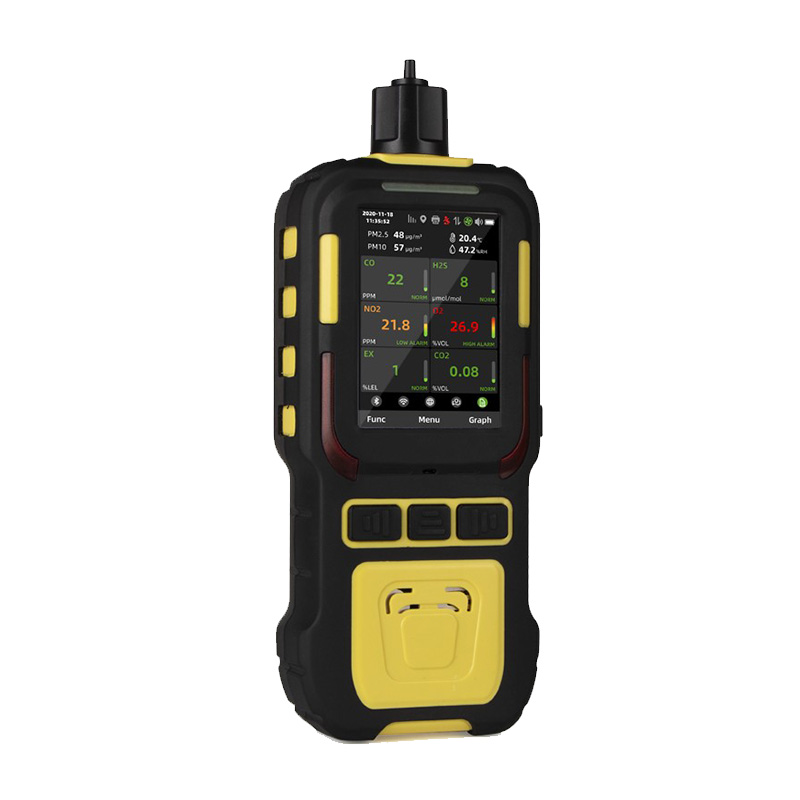
Bosean’s K-600M is configured for shipboard spaces such as engine rooms, cargo holds, pump rooms, ballast tanks, and confined-space entry points. The supplied marine configuration monitors carbon monoxide, hydrogen sulfide, oxygen, carbon dioxide, and methane. It combines NDIR sensors for carbon dioxide and methane with electrochemical sensors for oxygen, carbon monoxide, and hydrogen sulfide.
The built-in pump allows sampling from locations that may be unsafe or difficult to enter immediately. Product information also describes a color display with gas-curve viewing, sound, light, vibration, and display alarms, as well as pump-failure alerts and data storage. Its stated IP65 protection and explosion-protection marking should be checked against the vessel’s area classification and applicable approval requirements before use.
The K-600M is relevant when marine teams need carbon dioxide and methane monitoring alongside toxic gases and oxygen. Confirm the delivered sensor configuration, runtime, calibration process, and accessories. A portable gas detector is suitable only when its approved configuration matches the atmosphere and work procedure.
Choosing a Supplier and Managing the Equipment
A gas detector manufacturer should provide more than a product catalogue. Procurement teams should request current datasheets, certificates, manuals, sensor-life information, calibration instructions, spare-part availability, and details of local service support. They should also confirm whether the instrument is approved for the intended hazardous area; an IP rating alone does not establish explosion safety.
Before deployment, define bump-test and calibration schedules, training, alarm-response procedures, and records. Inspect pumps, filters, tubing, batteries, and sensors as directed. A single-gas or limited-sensor instrument is not a complete atmospheric assessment where multiple hazards may occur.
A gas detector manufacturer should also clarify configuration limits and sensor interference. Fleet managers can then compare calibration gases, service intervals, replacement sensors, training, and downtime. The supplier should provide clear guidance on sensor compatibility, calibration gases, replacement intervals, and documentation required for audits. On ships and in confined spaces, monitoring complements—not replaces—permits, ventilation, attendants, and rescue planning.
Making a Practical 2026 Purchasing Decision
Honeywell, RKI, and Bosean address different priorities. Honeywell’s BW Ultra offers broad sensor choices, a built-in pump, and connectivity; RKI’s GX-3R emphasizes compact personal four-gas monitoring; and Bosean‘s K-600M focuses on pumped marine monitoring with NDIR and electrochemical sensing. The best choice depends on the gases, sampling distances, approvals, operating conditions, and support available to the buyer.
A portable gas detector should be selected against a documented risk assessment and verified configuration, not a headline feature list. By comparing technical evidence and service arrangements, industrial buyers can choose equipment that fits the work, supports consistent procedures, and contributes to safer operations.